
Warli Print on a Kurti: What the Motifs Actually Mean, and How to Wear One
Warli print on a kurti is Maharashtra's white stick-figure folk art printed on cotton. What the circles, triangles and squares mean, and how to wear one.
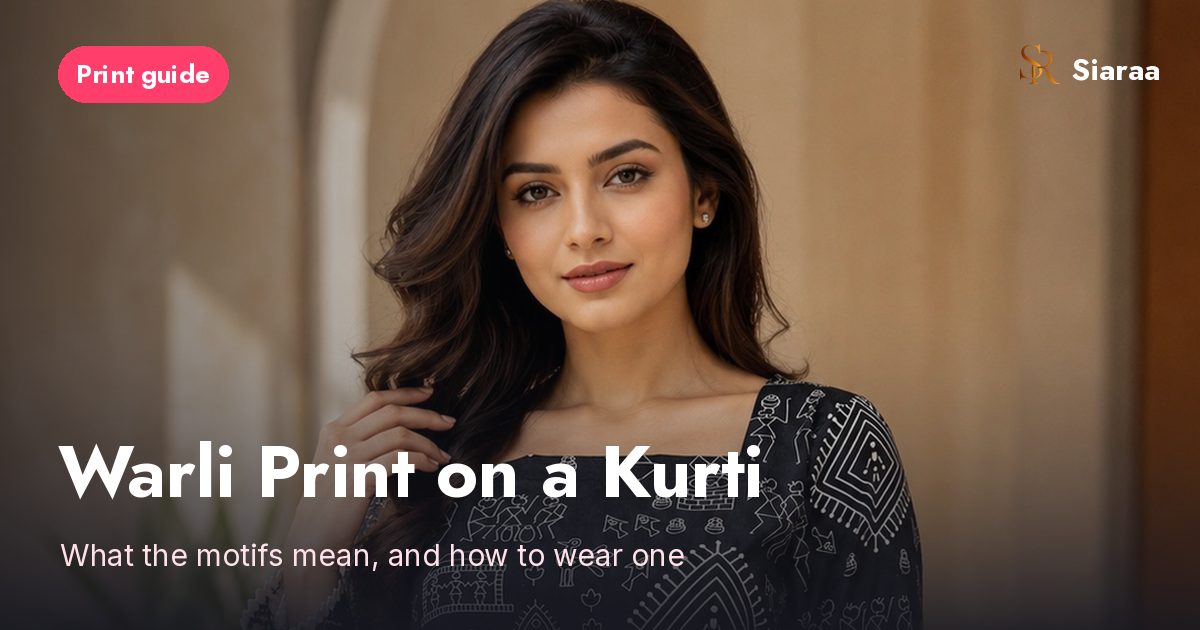
A Warli print kurti is a cotton kurti printed with Warli painting — the white stick-figure folk art of the Warli tribe of Maharashtra's Palghar belt, drawn almost entirely from three shapes: the circle, the triangle and the square.
What Warli print actually is
Warli painting belongs to the Warli (or Varli) people of the North Sahyadri range, centred on Palghar district in Maharashtra near the Gujarat border — Dahanu, Talasari, Jawhar, Mokhada. It is ritual wall art, traditionally made by women: a hut's inside wall is plastered with earth and cow dung to a red-ochre brown, then drawn on in one white pigment of rice flour, water and gum, applied with a chewed bamboo stick. Walls were painted for a wedding, a harvest or a festival, not to decorate a room.
Dating it is where most articles overreach. Warli painting is documented back at least to around the 10th century CE; claims of far older, prehistoric roots are claims, not settled fact. From the 1970s it moved onto paper and canvas, largely through the work of Jivya Soma Mashe.
None of that happens on a kurti: a print reproduces the visual language on cloth — the motifs, not the method. Siaraa sells its own catalogue of women's ethnic and everyday wear, priced in INR, with free shipping across India and 5-day returns.
Why it is almost always white on a dark ground
The Warli paint in one colour, on a brown-red earthen wall. That single-pigment contrast is the whole visual identity of the art form, which is why printed Warli reads correctly on black, indigo or terracotta and goes chalky on pastels. Siaraa's black Warli printed cotton ethnic kurti follows it: Pure Cotton, square neck, long sleeves, straight cut, ₹799 (MRP ₹1,399).
What the Warli motifs mean
Warli is unusual for what it leaves out. There is no crowded pantheon — the clearest deity is Palaghata, the mother goddess, drawn inside the ritual square — and almost no faces: a Warli person is a plain circle of a head with nothing inside it.
| Motif | What it looks like | What it traditionally stands for |
|---|---|---|
| Circle | A closed ring, repeated | The sun and the moon, from observing nature |
| Triangle | A wedge, point up or down | Mountains and conical trees — the hills the Warli live in |
| Square (chauk) | A framed box of pattern | A human invention: sacred enclosure or plot of land; the Lagnachauk is the wedding square |
| Human figure | Two triangles tip to tip, stick limbs, blank head | The body in balance: torso above, pelvis below |
| Tarpa spiral | Figures curling around one musician | The harvest dance around the tarpa piper; an unbroken circle of life |
| Tree and palm | Tall tapering forms | The forest the village lives off — food, shade, shelter |
| Cattle, deer, roosters | Built from the same triangles | The working village: farming, hunting, livestock, not mythology |
Reading a Warli print before you buy it
This is a composition judgement, not an authenticity test. A well-drawn Warli print keeps the grammar: two triangles meeting cleanly at a point, an unbroken tarpa spiral, motifs at consistent scale, negative space left alone. A filler print scatters figures at random sizes.
Warli vs the other folk prints on Indian kurtis
The prints sharing a kurta rail are not the same kind of thing. Warli and elephant motifs are figurative; paisley and lotus are botanical ornament; ikat is made at the yarn stage; and hand block is a method, not a motif.
| Origin | What it depicts | Reads as | At Siaraa | |
|---|---|---|---|---|
| Warli | North Sahyadri, Palghar belt, Maharashtra | Village life in white stick figures | Graphic, monochrome | Black Warli cotton kurti — ₹799 |
| Ikkat-style woven design | Ikat traditions of Telangana, Odisha, Gujarat | Blurred-edge geometric bands | Textural, quiet | Blue Aura Tribal Ikkat Kurta — ₹899 |
| Elephant / hathi | Pan-Indian; strongest in Rajasthan | Repeating elephant figures | Playful on plain cotton | Blue elephant cotton kurta — ₹1,199 |
| Paisley / buta | Persian-Indian, the mango-drop curve | A teardrop with a curled tip | Ornamental, traditional | Rani pink paisley kurta — ₹899 |
| Lotus / kamal | Pan-Indian botanical motif | Open bloom and petals | Soft, festive-leaning | Saanjh lotus top — ₹899 |
| Hand block | A method, not a motif | Whatever the block carves | Irregular repeat | Hand-block blue cotton top & skirt set — ₹1,299 |
Ikat earns its feathered edges because the yarn is resist-dyed before weaving. Siaraa's catalogue records the Blue Aura kurta's pattern simply as a woven design.
Is a printed Warli kurti "real" Warli?
No, and it is better to say so. Warli painting is registered as a Geographical Indication in India — filed by the tribal organisation Adivasi Yuva Seva Sangh, in place since 2014 — covering the painting as a craft, made by Warli artists on wall, paper or canvas. A printed garment carries no GI.
That does not make a printed kurti dishonest. It makes it a ₹799 printed cotton garment carrying a folk motif — a fine thing to be, provided it is priced and bought as one rather than as art.
Two co-ord sets carry "Hand Block Printed" in their names, including the sleeveless blue cotton top and skirt set at ₹1,299 — but a name is written by a merchandiser, not a process record, and it is weaker evidence than your own eyes. How to tell a hand block print from a machine print sets out the six checks you can run on any photograph. Everywhere else the listing records fabric, pattern, neck, sleeve and wash care, and nothing more is claimed here.
How to wear a Warli print kurti
Warli is high-contrast line art doing all the work already, so what surrounds it stays quiet: one print, one metal, plain bottoms.
Bottoms and layers
A straight-cut Warli kurti sits best over white or off-white cotton palazzos, straight pants or a slim churidar; the rule that matters is no second print below the waist. The long-sleeve, square-neck cut suits office, college and travel days — the rest of the cotton kurtis carry it in lighter prints.
Colour and jewellery
Keep it monochrome: oxidised silver over gold, one statement piece rather than three, solid dupattas or none. Ornamental prints take colour better — a beige paisley-design kurti or a peach lotus kurta set at ₹1,699 wears gold comfortably.
Office, weekend and festive
Office: stone or white straight pants, small silver studs. Weekend: denim or palazzos, one oxidised piece. Festive: this is a daytime-function piece, and in 2026 that window runs Sharad Navratri 11–19 October, Dussehra 20 October, Karwa Chauth 29 October and Diwali 8 November — for evening, a coordinated kurta set does more.
Keeping a printed cotton kurti sharp
The black ground is the vulnerable part, not the print. Wash cold and inside out, dry in shade — Indian sun fades dark cotton faster than the machine does — and iron on the reverse. Follow the wash-care line on the product page itself. For how dark cotton behaves in Indian heat, see the summer guide.
FAQ
What is Warli art and where does it come from?
Warli art is a tribal painting tradition of the Warli people of the North Sahyadri range, centred on Palghar district in Maharashtra near the Gujarat border. Women traditionally paint it on mud hut walls in a white pigment of rice flour, water and gum, applied with a chewed bamboo stick. It is documented back at least to around the 10th century CE.
What do the circle, triangle and square mean in Warli painting?
The circle stands for the sun and the moon, the triangle for mountains and conical trees. The square is a human invention — a sacred enclosure or plot of land — and the ritual chauk is the centre of a ceremonial painting. Figures are two triangles joined at their tips: torso above, pelvis below.
Is a Warli print kurti hand-painted or machine-printed?
Printed. A Warli print kurti reproduces the Warli visual language on finished cloth, and should be priced and sold as printed fabric. Hand-painted Warli is made by Warli artists on wall, paper or canvas, and is bought as art at art prices.
What is the difference between Ikkat and Warli print?
Different categories of thing. Warli is a figurative motif — white stick figures of village life — printed onto finished cloth. Ikat is a technique: the yarn is resist-dyed before weaving, which gives the soft feathered edges, and the pattern is geometric rather than pictorial.
Which print is best for a kurti?
It depends on what the kurti has to do. A monochrome graphic print like Warli is the most versatile for daily and office wear, because it behaves like a neutral against plain bottoms. Ornamental prints — paisley, lotus, floral — read dressier and take gold better.
What colour goes with a black Warli print kurti?
White and off-white are sharpest: the print is already white, so a white palazzo continues the line instead of competing with it. Ivory, stone, grey and unbleached beige work the same way. Keep metal to oxidised silver, and skip a second print below the waist.
Shop Siaraa's printed cotton kurtis
Warli, paisley and floral prints on cotton, cut for everyday Indian wear. Prices in INR, free shipping across India, 5-day returns.
Shop cotton kurtisKeep reading
How to Style a Kurti with Jeans: Which Hem, Which Denim, and Where the Side Slit Goes
A kurti works over jeans when the hem lands above mid-thigh, or higher up when side slits let it move. Which denim to pair, and the two combinations that fail.
Office Wear for Indian Women: What Actually Survives Eight Hours at a Desk
Office dressing is decided by the commute, the air conditioning and eight hours seated — not by formality. What to wear to work, and what to buy twice.
What to Wear with Palazzo Pants: The Hem Landing That Decides Every Top
Palazzos supply all the volume, so the top must not. Where the hem has to land, which kurtas and kurtis work, and the pairing that always looks unfinished.