
Summer Fashion Guide for Indian Women (2026): Fabrics, Outfits & Styling
Cotton, linen and rayon beat the Indian summer — here's how to pick the right fabric, the outfits that actually stay cool, and how to style them.
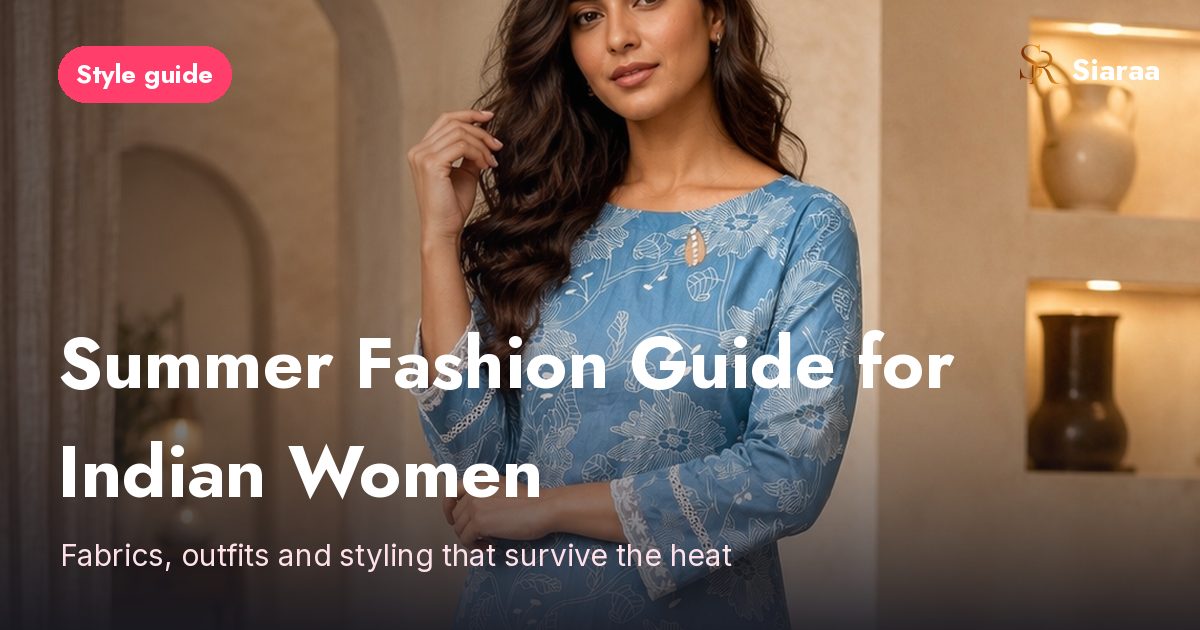
For an Indian summer, the fabric matters more than the outfit. Pure cotton is the single best choice for 35 °C-plus daytime heat — it is breathable, absorbs sweat and washes easily. Linen is cooler still but creases; rayon and chiffon drape beautifully but trap heat if they are lined. Everything else — polyester, heavy georgette, anything with a stiff lining — will make a well-cut outfit feel worse than a plain cotton kurta.
This guide covers what to actually wear through April to July in India: which fabrics work, which silhouettes keep air moving, how to handle colour in strong sun, and how to style it all without looking like you dressed for the weather instead of the day.
Summer fabrics, ranked
| Fabric | How it feels in heat | Creases? | Best for |
|---|---|---|---|
| Pure cotton | Excellent — breathable, absorbs sweat | Some | Daily wear, office, college |
| Cotton blends | Very good — a little less absorbent | Less | Everyday wear you wash often |
| Linen | Best-in-class airflow | Yes, heavily | Weekends, travel, relaxed occasions |
| Rayon / viscose | Good if unlined, poor if lined | Little | Drapey kurtas, flowy dresses |
| Chiffon / georgette | Light, but warm when layered | No | Evening events, dupattas |
| Polyester | Poor — traps heat and odour | No | Avoid in peak summer |
The practical rule: if you can hold the fabric to a light and see through the weave, air can move through it. That single test predicts summer comfort better than any label.
That table compares fibre families. Cotton itself splits into several weaves — mul, voile, cambric, poplin and slub — that behave quite differently in heat, and types of cotton fabric for kurtas compares them properly, including what a product page's Fabric line does and doesn't tell you.
Why lining ruins good fabric
A rayon kurta with a full polyester lining is a polyester kurta as far as your skin is concerned. Before buying anything for summer, check the lining — an unlined or cotton-lined piece will always be cooler than the same design lined in synthetic fabric.
The five summer silhouettes that work
Airflow beats fabric weight. A loose synthetic will often feel better than a tight cotton, so cut matters almost as much as material.
- Straight-cut cotton kurtas. The workhorse. Skims rather than clings, works over palazzos or jeans, and takes prints well. Siaraa's cotton kurtas sit at ₹899–1,199 — the rani pink paisley pintuck kurta and the light blue floral boat neck kurta are both cotton with three-quarter sleeves. Browse all cotton kurtas.
- Shorter kurtis. Less fabric overall, and a hem that ends above the calf so the legs stay clear. Good for long commutes and standing days. The pure-cotton off-white petal kurti at ₹699 and the beige paisley kurti at ₹799 are both in the kurti range — Siaraa records every kurti as Shape "Straight", so if you want a flared hem, look at the A-line kurtas instead.
- Tunic tops. Shorter, lighter and easier with trousers or denim. The sky blue floral everyday tunic (₹699, pure cotton) and the floral print casual top (₹699) both work from morning to evening — see all tops.
- Maxi and Anarkali dresses. One layer, full coverage from the sun, nothing pinching at the waist. The single easiest "get dressed in ten seconds" option — the sleeveless tiered cotton midi dress at ₹1,299, which is the one dress that records Cotton on its listing, or the pure-cotton floral Anarkali with dupatta when the day needs more. Siaraa's other three dresses record no fabric at all — check the listing before you count on one for heat.
- Co-ord sets. A matched top and bottom in the same light fabric removes the decision entirely and photographs well. The hand block printed blue cotton sleeveless top and skirt set is pure cotton and sleeveless at ₹1,299.
What to avoid: anything with a tight waistband, heavy embroidery across the back, or full sleeves in a non-breathable fabric.
Colour in strong Indian sun
Light colours reflect heat — that part is true. But the useful version of the advice is about print and finish, not just shade:
- Whites, pastels and light neutrals stay coolest and read as fresh even after a long day.
- Small, busy prints (florals, ikat, block prints, warli) hide sweat marks and travel dust far better than flat solids. This is why block-printed cotton has been the Indian summer default for centuries. In Siaraa's range that means the turquoise block-printed kurta set, the blue aura ikat kurta, or the black warli-printed kurti — and what warli print actually is if you want the background.
- Deep colours — navy, maroon, rani pink — are perfectly fine in the evening once the sun is down, and they photograph beautifully indoors. The maroon floral kurti at ₹799 is the easiest way in.
- Avoid high-shine finishes in daylight; matte cotton looks better in harsh sun than anything with sheen.
Styling: three outfits that cover most days
Workday. Straight cotton kurta in a light print + straight cotton pants + flat sandals. A cotton kurta in a small print does the work here; add a thin dupatta only if the dress code needs it — carry it, don't drape it, until you're in air conditioning.
College or casual. Tunic top + high-waisted cotton trousers or denim + sneakers. The embroidered yellow casual top (₹699) or the floral printed peplum top (₹799) both take denim well. Roll the sleeves, keep jewellery minimal — one pair of earrings you already own does more than a stack of bangles in the heat.
Evening out. Flowy A-line or Anarkali dress + the flats or block heels already in your cupboard. The floral Anarkali with dupatta is one pure-cotton layer with nothing that needs adjusting.
Accessories that earn their place
Sunglasses and a wide-brim hat are genuinely functional, not just styling. Beyond that, keep it light: a woven or canvas bag instead of leather, open footwear (flats, sandals, espadrilles) instead of closed shoes, and hair off the neck.
Caring for summer cotton so it lasts the season
Cotton's weakness is that it fades and shrinks when handled carelessly. Four habits keep a summer wardrobe looking new:
- Wash cold, inside out. Protects prints and dyes from fading in the first few washes.
- Dry in shade, not direct sun. Strong Indian sunlight bleaches colour out of cotton faster than the washing machine does.
- Skip the dryer. Air-drying prevents most shrinkage.
- Iron slightly damp. Cotton and linen press far more easily before they're bone dry.
Building a small summer capsule
You do not need a large wardrobe to get through summer well. Six pieces cover almost every situation:
- 2 straight-cut cotton kurtas in light prints — e.g. the black and white printed kurta with lace and the yellow floral embroidered kurta, both ₹899
- 1 shorter kurti — the off-white petal cotton kurti, ₹699
- 1 tunic top that works with both trousers and denim — the lime green flared top with polka dots, ₹699
- 1 maxi or Anarkali dress — the sleeveless tiered cotton midi dress, ₹1,299
- 1 pair of cotton palazzos or straight pants that matches everything. Siaraa's kurta sets ship with matching palazzos from ₹1,299, which solves the bottom half and the top half at once
Everything in that list is one layer, breathable, and mixes with the rest. Add colour and print rather than more fabric.
None of it is wasted when the weather turns, either — the same cotton pieces carry into the cold once you layer them, which how to layer a kurta in winter covers in detail.
FAQ
Which fabric is best for Indian summer?
Pure cotton. It is breathable, absorbs sweat and dries quickly, which is exactly what 35 °C-plus humid heat demands. Linen is slightly cooler but creases heavily, and unlined rayon is a good drapey alternative. Avoid polyester and anything with a synthetic lining in peak summer.
What should I wear to work in summer in India?
A straight-cut cotton kurta with cotton straight pants and flat sandals is the most reliable office combination — it looks formal enough for most Indian workplaces while staying breathable. Choose a small print over a flat solid; it hides sweat marks and commute dust much better.
Are dark colours bad for summer?
Not automatically. Light shades reflect more heat and are the better choice for long stretches in direct sun, but deep colours are fine for evenings and indoor days. The finish matters more than people expect — matte cotton in navy will feel cooler in the sun than a shiny synthetic in white.
How do I stop cotton kurtas from fading?
Wash them cold and inside out, and dry them in shade rather than direct sunlight. Indian summer sun bleaches cotton dye faster than washing does, so shade-drying is the single most effective habit. Skip the tumble dryer to avoid shrinkage.
Do I need to wear a dupatta in summer?
No — a straight kurta with trousers is a complete outfit on its own. If your setting expects one, carry a light cotton or mul dupatta and drape it only when needed rather than wearing it through the commute.
What is the easiest summer outfit to put together?
A maxi or Anarkali dress. It is a single breathable layer with no waistband, needs no coordination, and works for everything from a day out to an evening event — which is why it is the most common answer to "I have nothing to wear" in peak summer.
Shop breathable summer cotton
Siaraa's cotton kurtas, kurtis and tops are cut for Indian summers — free shipping across India, easy 5-day returns.
Shop women's collectionKeep reading
Office Wear for Indian Women: What Actually Survives Eight Hours at a Desk
Office dressing is decided by the commute, the air conditioning and eight hours seated — not by formality. What to wear to work, and what to buy twice.
What to Wear with Palazzo Pants: The Hem Landing That Decides Every Top
Palazzos supply all the volume, so the top must not. Where the hem has to land, which kurtas and kurtis work, and the pairing that always looks unfinished.
How to Layer a Kurta in Winter: What Goes Under, What Goes Over, What Changes at the Bottom
Layer a kurta for Indian winter by position — a full-sleeve tee underneath, one outer layer that respects the hem, and a narrower bottom.